

Choosing a web development company in Singapore is less about portfolios and price, and more about a handful of questions that predict whether the software will get used. This guide covers the questions that matter, the red flags worth walking away from, and a simple checklist to compare shortlisted partners.
Most businesses pick a development partner the same way. They collect three quotes, glance at the portfolios, and choose somewhere in the middle on price. A few months later, a fair number of them are unhappy, and the reason is almost never the one they screened for.
The build that goes wrong usually passed every surface check. The company had a nice website, a client logo wall, and a confident sales call. What it did not have was a clear answer to the questions that actually matter. This guide gives you those questions, so you can tell a good app development company in Singapore from one that merely looks the part.
Start with your problem, not their tech stack
Before you talk to anyone, write down the single workflow that hurts most, not a wishlist of features. In the average software product around 80% of features are rarely or never used, so a partner who fixates on the feature list is optimising for the wrong thing from the first meeting.
That 80% figure comes from a large feature-adoption study by Pendo, and it explains a lot of failed builds. Write down who touches the painful workflow, where it gets stuck, and what a good day would look like if it worked. That one paragraph will tell you more about a potential partner than any feature comparison, because the good ones will ask about the workflow and the weak ones will ask about the feature list.
If a company jumps straight to frameworks and databases before understanding your problem, note it. The technology is the easy part. Understanding the work is the part that separates a build that sticks from one that gets abandoned.
The five questions that predict a good build
Ask every shortlisted partner these five questions: do they design before they code, can they show working software they built, what do you own at the end, how do they handle your data and PDPA, and are they comfortable starting small. How readily each answer comes matters as much as the answer itself.
1. Do they design before they code?
A good partner can show you the thinking behind an interface, not just the finished screen. This matters because users judge a design in about 50 milliseconds, so usability is what decides whether software gets adopted, no matter how strong the code underneath is.
That 50-millisecond finding, from research at Carleton University and echoed by Google’s work on first impressions, is why design cannot be an afterthought. Ask to see how a past project moved from problem to interface: the workflow they mapped, the steps they cut, the reason a screen looks the way it does. A partner who treats design as decoration bolted on at the end will hand you something technically complete and practically ignored.
2. Can they show working software, not just slides?
Portfolios are easy to polish. Working software is not. Ask to click through something real, ideally a tool the company built and still runs.
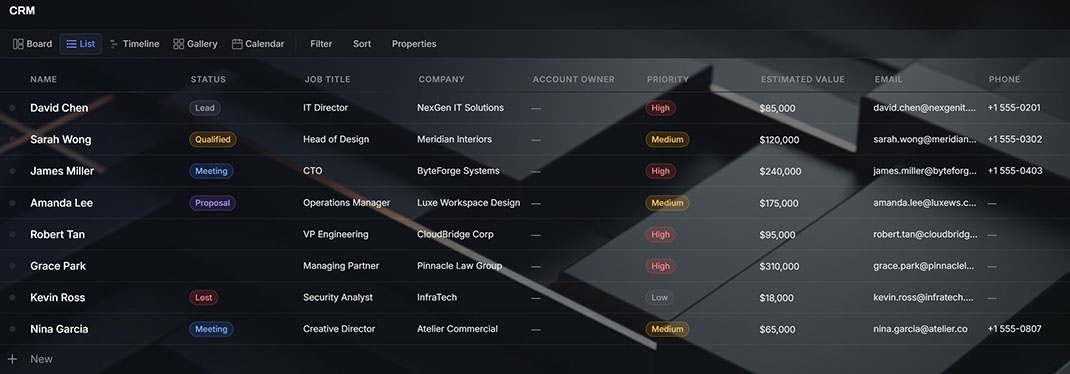
The strongest signal is a partner that builds and uses its own products, because it means they live with their own decisions. At MT Labs, for example, we run the tools we recommend, from a smart CRM to a private AI chat platform, and you can click through them on our work page rather than take our word for it.
3. What do you actually own at the end?
This is the question most buyers forget, and it is one of the most important. When the project is finished, what is yours.
Get a clear answer on three things: the source code, the data, and the hosting. Some partners hand over a genuine asset you control. Others hand over a login to software that lives on their cloud, bills per user every month, and becomes painful to leave. Neither is automatically wrong, but you should know which one you are buying before you sign, not after.
4. How do they handle your data and PDPA?
Any software that touches customer information carries a data-protection obligation. Ask where your data will physically live, who else can access it, and how the setup maps to PDPA requirements.
The cleanest answer is usually the simplest: data that stays inside your own environment cannot be leaked from someone else’s. It is worth noting that as AI adoption among Singapore SMEs tripled in 2024, only around 44% of AI-using firms used customised or private systems, according to the IMDA Singapore Digital Economy Report, which means most are sending data to third-party tools by default. A partner who can build and run software on infrastructure you own makes that a choice rather than an accident.
5. Do they start small, or sell you the whole build?
A partner who insists on a large, all-at-once build before you have seen anything working is taking on risk with your money. The better pattern is a small, focused first version that solves one real problem, gets into people’s hands, and earns the next stage.
Watch how they react when you propose starting small. Confidence looks like agreement. Discomfort often means the business model depends on the big number.
Red flags worth walking away from
Some signals are worth treating as a firm no, however good the sales call felt: a quote before they understand the problem, features with no mention of workflow, no software they can show you, vague ownership terms, and discomfort around the data question.
- They quote before they understand the problem. A fast price on a vague brief is a guess, and you will pay for the gap later in change requests.
- Everything is a feature, nothing is a workflow. If they never ask how your team actually works, the software will reflect that.
- They cannot show you anything they built and run. Slides and stock screenshots are not evidence.
- Ownership is vague. If you cannot get a straight answer on code, data, and hosting, assume the answer is one you will not like.
- The data question makes them uncomfortable. For anything touching customer records, this is disqualifying.
None of these require technical knowledge to spot. They are all about how a partner thinks, which is exactly what you are hiring.
A simple way to compare shortlisted partners
You do not need a complex scoring matrix. Score each shortlisted partner from one to five on six points: understood the problem, showed design thinking, demonstrated working software, gave a clear ownership answer, handled the PDPA question well, and was comfortable starting small.
- Understood the problem before talking technology.
- Showed design thinking, not just finished screens.
- Demonstrated working software they built themselves.
- Gave a clear ownership answer on code, data, and hosting.
- Handled the PDPA question with a concrete, sensible plan.
- Was comfortable starting small with a focused first release.
A partner that scores well here will almost always deliver software your team uses. A partner that scores well only on price and portfolio is the one that quietly disappoints six weeks in.
Where MT Labs fits
MT Labs is a Singapore team that leads with design and workflow, builds and runs its own custom software, and delivers projects you own outright on infrastructure you control. We are a strong fit if you want software people actually use and if data privacy matters to you.
We built this guide around how we work, so it is fair to say where we sit. See our approach to web and app development in Singapore, or read how the same design-and-ownership thinking plays out in custom software for Singapore SMEs.
We are an honest mismatch if a standard off-the-shelf tool already does the job well, and part of our job is telling you when that is the case.
Summary
Choosing a web or app development company in Singapore comes down to a few questions most buyers skip: do they design before they code, can they show working software, what do you own, how do they handle your data, and will they start small. Score your shortlist on those, watch for the red flags, and the right partner tends to stand out on its own.
MT Labs helps companies across Singapore deploy AI tools they actually own. Private infrastructure, no recurring cloud subscriptions, and a setup built around how your team already works. AI isn’t right for every workflow, and part of our job is telling you where it isn’t. Get in touch and we’ll walk through where it makes sense, and where it doesn’t, for your business.

FAQ
How much should web or app development cost in Singapore?
Cost depends entirely on scope, so treat any figure quoted before a proper conversation as a guess. What matters more than the number is clarity: a clear scope, a clear view of what recurs monthly, and no surprise per-seat fees that grow as your team does. We prefer to understand the problem first, then talk about what a sensible first release involves. For specifics, it is best to get in touch.
Should I build a web app or a mobile app?
Start from how your users work. If they mostly work at a desk or across shared devices, a web app is usually faster to build and easier to maintain, and it works on any device from one codebase. If they need offline use, camera, or on-the-go notifications, a mobile app earns its place. A good partner will recommend based on the job, not on what they prefer to build.
What questions should I ask a development company before hiring them?
The five that predict success: do they design before they code, can they show working software they built, what do you own at the end, how do they handle your data and PDPA, and are they comfortable starting small. How readily they answer matters as much as the answers themselves.
How do I make sure the software is PDPA compliant?
Ask where your data will live and who can access it. The simplest safe answer is software that runs on infrastructure you own, so customer data stays inside your environment rather than on a third-party cloud. Data that never leaves the building is far easier to keep compliant.
Is it better to hire a Singapore-based development partner?
For anything involving local data, compliance, and ongoing support, a Singapore-based partner who understands PDPA and can meet in person is usually worth it. Proximity matters most when the work touches sensitive data or needs close collaboration with your team.
What is the biggest mistake businesses make when choosing a partner?
Screening on price and portfolio while ignoring workflow and ownership. The build that fails almost always passed those surface checks. It failed on the questions nobody asked.


