

Modern office with employees working at desks under bright industrial lighting

Locally Hosted AI Deployment: A Practical Guide for Singapore Businesses

Locally Hosted AI Deployment: A Practical Guide for Singapore Businesses

Locally hosted AI means running AI models (LLMs, vision, speech, image generation) on hardware you own, inside your network, with your data never leaving your environment. For Singapore businesses subject to PDPA, working with sensitive data, or running at enough scale where cloud costs compound, local deployment is the practical alternative to cloud AI. This guide covers what it involves, what it costs and when it makes sense.

What Locally Hosted AI Actually Means

When you call ChatGPT, Claude, or Gemini through their APIs, your prompt leaves your network, travels to a cloud provider (likely outside Singapore), gets processed on their hardware and the response comes back. You pay per call, your data is stored on their servers (at least temporarily) and you have no control over when the model changes underneath you.

Locally hosted AI flips this. The model runs on a server in your office or a Singapore data centre you control. Your prompts and data never cross your network boundary. You pay for the hardware once, not per call. And the model does not change unless you decide to update it.

The models that power local deployments are open-weight models: Mistral from France, Qwen from Alibaba, Gemma from Google. Many are competitive with proprietary cloud models for most business tasks and you can download and run them freely.

Why Singapore Businesses Are Moving Local

Four reasons show up repeatedly in the conversations we have:

1. Data sovereignty and PDPA

Singapore’s Personal Data Protection Act requires businesses to know where personal data is stored and to protect it against unauthorized access. Cloud AI APIs add third-party data flow complexity to every AI-assisted workflow. Local deployment removes that concern entirely, because the data never leaves your network.

For regulated industries (finance under MAS TRM, healthcare under MOH guidelines, legal and professional services), this is not a preference. It is a requirement.

2. Cloud cost compounds badly

Cloud AI has a low entry price. A few hundred dollars a month for a pilot. But once an AI workflow catches on and usage grows, the invoice scales with it. Teams we talk to routinely report cloud AI bills growing faster than usage, because pricing compounds with every call. Private deployment has a higher upfront hardware cost but flat ongoing cost, which crosses over to cheaper within 6-12 months for most real workloads.

3. Vendor lock-in and model changes

Cloud AI vendors change their models on their own schedule. Your prompts that worked last quarter may produce subtly different output this quarter. Pricing changes. Rate limits change. For a business that depends on AI for core workflows, this is operational risk. With local deployment, the model stays exactly as you tuned it until you choose to update.

4. Speed and offline reliability

Local deployment removes network latency and keeps working when internet does not. For time-sensitive workflows (real-time voice, on-site inference, field operations), this is a structural advantage. For everyone else, it is a nice-to-have.

What Can Actually Run Locally in 2026

More than most teams realize:

  • Business-grade LLMs. Mistral, Qwen 3.5, Gemma 4, Zai 4.7 Flash run well on Workstations with GPU. Quality is competitive with cloud GPT-4-class models for volume tasks.
  • Smaller LLMs for simple tasks. Qwen Vl 4b run on a mid-range workstation GPU. Good for document classification, extraction and focused Q&A.
  • Speech-to-text and voice. Whisper-based models run offline with near-cloud quality. Our SecondSpeech app is an example.
  • Image generation. Z Image and Flux models run on a single 5090 GPU. Fully private image generation for design, e-commerce and product teams.
  • Embedding and retrieval. Vector search and semantic retrieval run easily on modest hardware.
  • OCR and document AI. Fully local pipelines handle invoices, receipts, contracts and structured extraction.
  • Multi-agent workflows. AI agents orchestrated locally through AgentsCommand.

Hardware Reality Check

The biggest fear we hear is “we do not have a server room.” You probably do not need one.

Small team (up to 20 users)

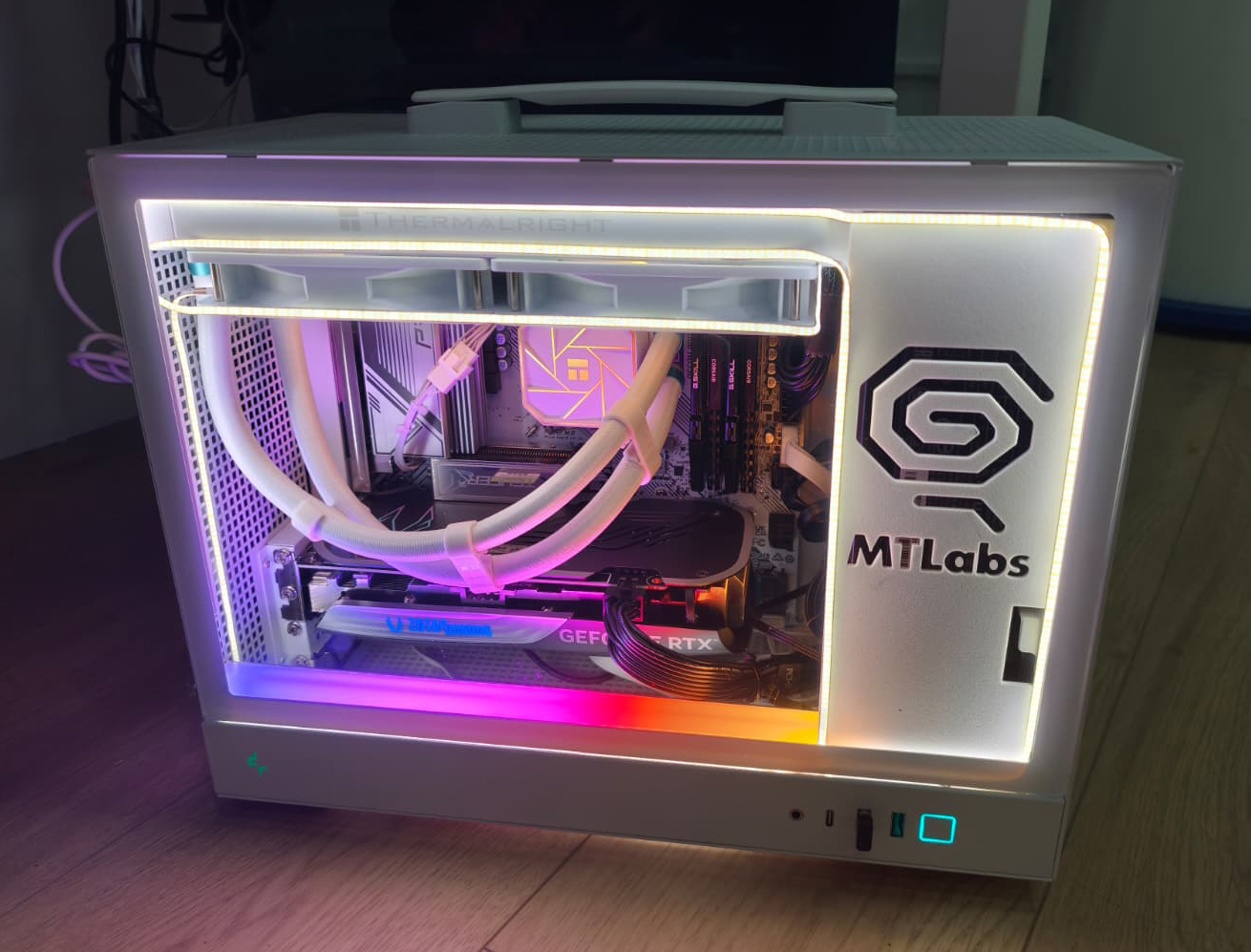
A workstation-class tower with a RTX 5090 or similar GPU handles most small-team workloads: text generation, document AI, image generation for a small creative team.

SME (50-100 users)

Multiple dedicated server with dual GPUs handles multi-team deployments with production-grade LLMs. 

Mid-market and enterprise (100+ users)

A small GPU cluster (4-8 data-centre GPUs) for concurrent high-volume workloads. At this point, a dedicated server room or colocation is usually involved.

For most Singapore SMEs, the first two tiers cover the real need. The hardware sits in a server cupboard or a corner of the office, with liquid cooling.

Modern white PC with RGB lighting and MT Labs branding on side panel

What a Deployment Actually Looks Like

Our typical local AI deployment has five phases:

  1. Scoping and sizing. Which workflows, how many users, what data sensitivity, compliance constraints. 
  2. Hardware procurement and install. We do hardware builds inhouse. Install and network configuration on-site. 
  3. Model selection and deployment. Pick the right open-weight models for each workflow.
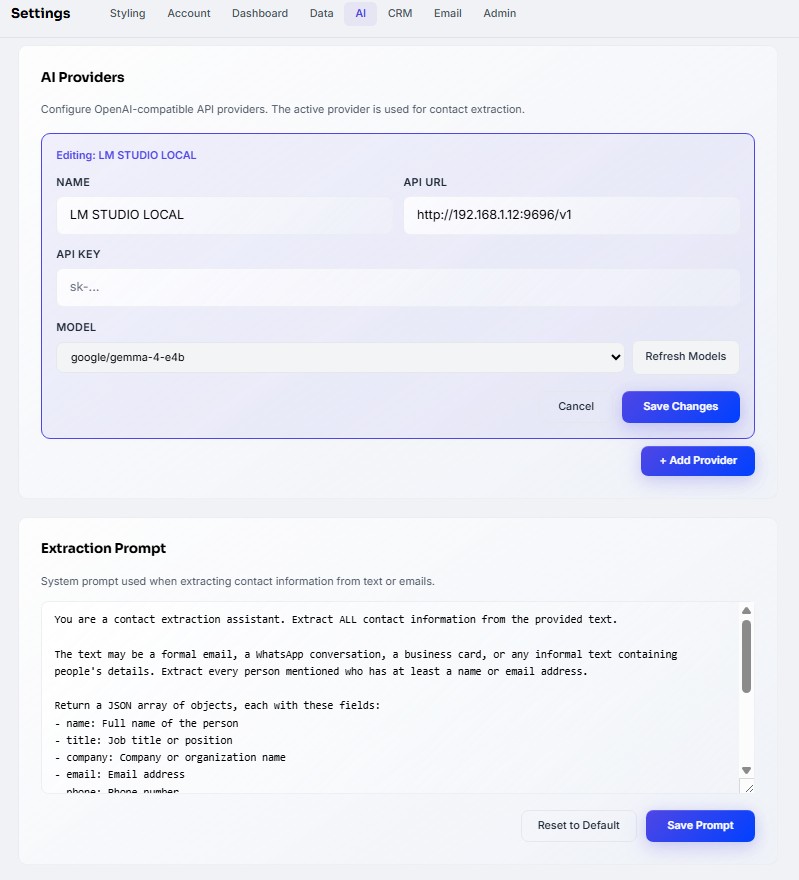
  4. Integration with existing tools. Connect to your CRM, document RAG, WhatsApp, email, Google Auth or whatever workflow needs AI. Timeline depends on integration complexity.
  5. Team training and handover. Your team learns to use, monitor and maintain the system. We document everything important.

Total project timeline for a standard SME deployment is 4-8 weeks from first call to production.

Where Locally Hosted AI Is Not the Right Answer

Honest list of where local deployment underperforms cloud:

  • Very low-volume workloads. If you only need AI for 50 tasks a month, cloud APIs cost less than owning hardware.
  • Workloads that need hyperscale bursts. If your traffic spikes 100x on peak days, cloud elastic scale is hard to match locally.
  • Cutting-edge capability that only exists in cloud models. Some frontier capabilities (very long context, specific multimodal features) are sometimes only available through cloud APIs. This gap narrows every quarter but is still real for certain niches like coding.
  • Teams with no infrastructure capacity. Local deployment needs someone who can own basic hardware health. If you have zero IT function, cloud is easier even if more expensive.

For most Singapore SMEs with data sensitivity and steady usage patterns, local deployment is the better economic and operational choice. For everyone else, hybrid is a reasonable middle ground: local for sensitive workloads, cloud for bursts and experimentation.

MT Labs helps companies across Singapore deploy AI tools they actually own. Private infrastructure, no recurring cloud subscriptions and a setup built around how your team already works. Whether you need a small assistant for one team or a full agentic AI for the whole company, we size the setup to what you need and what your team can manage. Get in touch and we’ll map it out with you.

Blue background with white icon resembling a speech bubble with a checkmark

Frequently Asked Questions

What does locally hosted AI mean?

Locally hosted AI runs AI models on hardware you own, inside your network, with your data never leaving your environment. The model processes prompts on your server, not a cloud vendor's. You pay for hardware once instead of per API call.

Is locally hosted AI cheaper than cloud AI?

Over 12-18 months, yes, for most real workloads. Cloud AI has a low entry price but per-call pricing compounds with usage. Their Prices will increase in future. Local deployment has higher upfront hardware cost but flat ongoing cost. The crossover point for most SMEs is a few hundred thousand tokens per day.

Does local AI deployment help with PDPA compliance?

Yes, significantly. Keeping data inside your network removes third-party data transfer concerns, simplifies audit trails and eliminates cross-border data flow notifications. For regulated industries (finance, healthcare, legal), local deployment often turns compliance from a blocker into a non-issue.

What hardware do I need for local AI?

For small teams up to 20 users, a workstation with a mid-range or high-end GPU (RTX 4090 or similar) handles most workloads. For SMEs with 50-100 users, a dedicated server with 2 GPUs (NVIDIA 5090, AMD 9070XT). For 100+ users or heavy concurrent use, you'll need multiple servers. We size the exact hardware based on your user count and workload shape. Drop us an email for more information.

Which AI models can run locally?

Most major open-weight LLMs: Mistral Large and Mistral Small, Qwen 3.5, Gemma 4, Zai 4.7 Flash. For specialist tasks: ComfyUI for image generation, embedding models for retrieval. Quality is competitive with cloud models for most business use cases.

How long does a local AI deployment take?

Standard SME deployments ship in 4-8 weeks from first call to production. This covers scoping, hardware procurement, installation, model selection, integration with existing tools and team training. Larger enterprise deployments with fine-tuning take 8-16 weeks.

What are local AI deployment downsides?

Higher upfront cost, hardware has to be sized upfront and you own the maintenance. For very low-volume use, cloud APIs are still cheaper. For teams with zero IT function, cloud is easier even if more expensive.

Chat with AI

Hello! I'm MTLabs AI, How can I help you today?